



0102030405
The Lawn-Care Tipping Point: Why 2026 Is the Year Robotic Mowers Finally Go Wire-Free
2026-06-25
Walk through any suburban neighborhood today, and you will notice a quiet shift. Lawns that once demanded the roar of a gasoline engine every Saturday morning are now kept pristine by silent, self-navigating machines. The robotic lawn mower, long dismissed as a niche gadget for tech enthusiasts, has reached a tipping point—and 2026 marks the year it goes mainstream.

The Numbers Tell the Story
The transformation is nothing short of dramatic. According to IDC data, wire-free robotic mowers accounted for just 35% of the market in 2024. By the first half of 2025, that share had surged to 65%—a historic reversal that saw wire-free models overtake traditional boundary-wire systems for the first time. For the full year 2025, global shipments of wire-free robotic mowers reached 1.318 million units, an astonishing 182.4% year-over-year growth. Traditional wired models, by contrast, declined 10.1%.
The overall robotic lawn mower market is accelerating accordingly. Valued at $3.08 billion in 2025, it is projected to reach $3.56 billion in 2026, growing at a compound annual rate of 15.4%. Some forecasts see the market reaching $5.32 billion by 2031. The wire-free segment alone is expected to grow from $739 million in 2025 to $932 million by 2031.
Why the Sudden Shift?
Three converging forces have driven this explosive growth.
First, the technology finally works.
Early robotic mowers were glorified bump-machines—randomly bouncing off obstacles and hoping to cover the lawn eventually. They required homeowners to bury hundreds of feet of boundary wire around the property, a labor-intensive process that could take an entire weekend. Any change to flower beds or walkways meant re-burying the wire.
Today’s wire-free mowers use RTK (Real-Time Kinematic) satellite positioning combined with computer vision and AI—a sensor fusion approach that delivers centimeter-level accuracy without a single buried cable. A small base station and the roaming robot compare signals from GPS satellites, achieving precision of about 2.5 cm (1 inch). This allows the mower to know exactly where the grass ends and the soil begins.
Second, the economics have flipped.
Professional lawn care in the U.S. and Europe costs between $1,200 and $2,500 per year. A quality robotic mower typically ranges from $800 to $3,000—meaning most homeowners recover their investment within one to two years. Over a five-year period, the savings can exceed $10,000 compared to hiring a service.
Third, regulation is accelerating the transition.
The European Union has proposed banning most gasoline-powered garden equipment by 2027. California and several other U.S. states have already adopted zero-emission mandates for new small off-road engines. Battery-electric robotic mowers produce zero direct emissions and operate at around 60 decibels—quieter than a normal conversation.
What a Modern Wire-Free Mower Actually Does
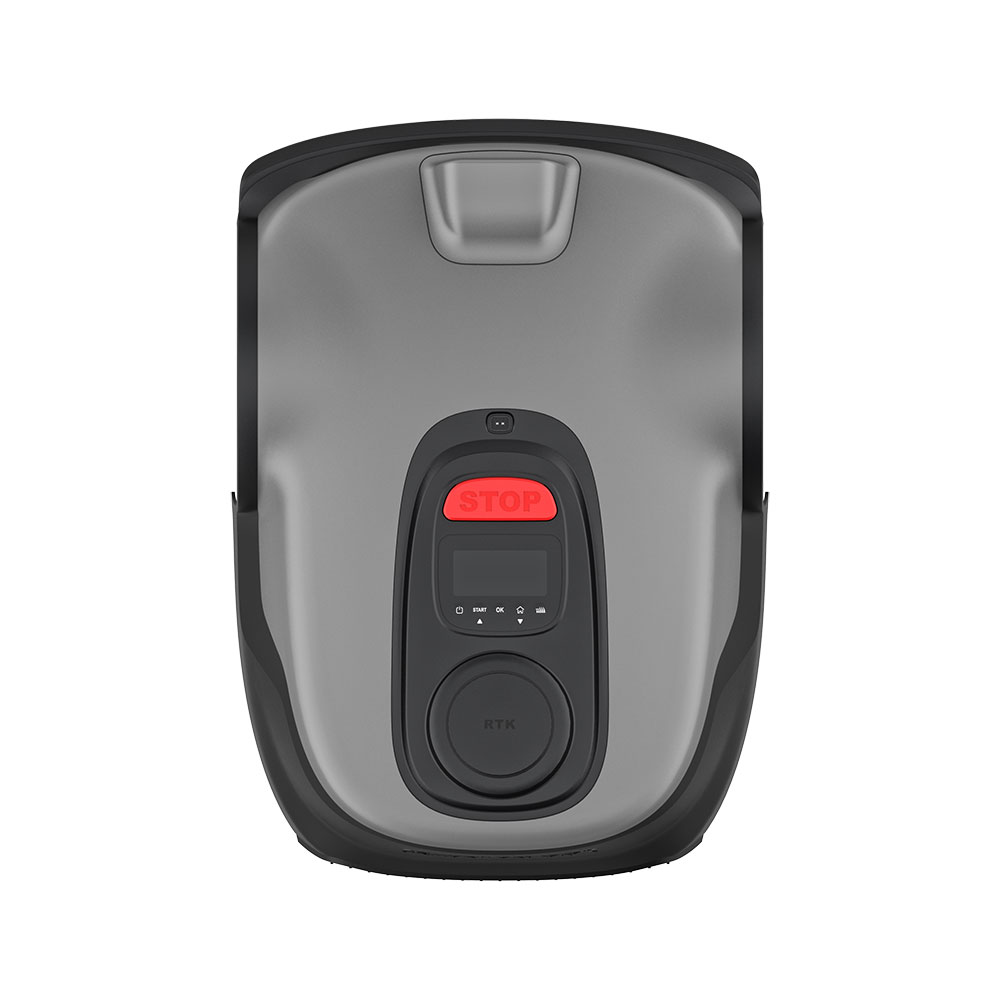
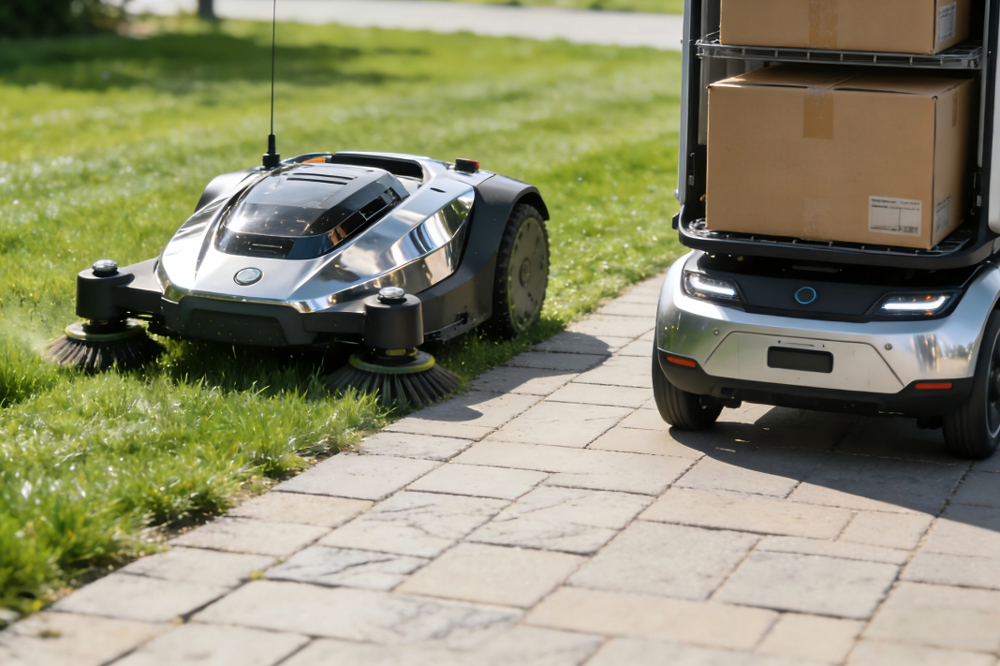
Take MHD Robot’s wire-free mower as an example of where the technology stands today. It combines RTK satellite positioning with a vision navigation system to achieve centimeter-level accuracy. The mower automatically maps the entire lawn area, plans the most efficient cutting path, and avoids missed corners or overlapping—greatly boosting efficiency while reducing energy consumption.
For obstacle avoidance, it integrates infrared sensors and ultrasonic detection alongside its vision system, allowing it to quickly identify and bypass stones, tree stumps, flower beds, and even small pets. A physical bumper provides a final layer of collision protection.
The mower supports up to 10 independent work zones, meaning the front yard, back yard, and narrow side strips can each have their own cutting schedule and height settings—manually adjustable from 30 mm to 90 mm. It handles slopes up to 35% (about 19 degrees) and operates in temperatures from 4°C to 40°C.
Battery life is another key improvement. With 6Ah or 9Ah options at 18V, a single charge covers about 300 square meters, and the mower cuts roughly 150 square meters per hour with its 22 cm cutting width. When the battery runs low, it automatically returns to the charging station, recharges, and resumes mowing exactly where it left off—eliminating the need for manual intervention.
The mower is IPX6 waterproof, includes a rain sensor that sends it home when precipitation starts, and features PIN code lock, alarm system, and optional 4G-based GPS tracking for theft protection.
The Global Landscape
Europe and North America together account for 72% of the world’s 250 million private gardens. Yet adoption remains remarkably low—under 6% in North America and between 10% and 30% in Europe. This represents enormous growth potential.
The industry is being reshaped by the shift from boundary-wire systems toward wire-free navigation using RTK-GNSS, computer vision, ultrasonic sensors, LiDAR, and sensor fusion. Traditional garden tool giants that dominated the wired era are now playing catch-up, while a new wave of technology-first companies—drawing on expertise from robotics, AI, and consumer electronics—are capturing the majority of growth in the wire-free segment.
What This Means for Homeowners
For anyone who has spent a Saturday morning wrestling with a pull cord, cleaning a gummed-up carburetor, or emptying a grass bag in the summer heat, the arrival of reliable wire-free mowers is genuinely transformative.
Installation today takes minutes, not hours. No digging. No wires. No contractors. Place the charging station, let the mower map the perimeter once, and it is ready to go. From that moment forward, the only decisions left are how tall you want the grass and what time of day you prefer it to be cut.
The lawn-care revolution is no longer coming—it is already here. And for millions of homeowners, the loud, smoky, labor-intensive weekend chore is rapidly becoming a memory.